

The Many Urban Indias
Rajesh Shukla
Published Report | PRICE and Tata Sons Ltd.
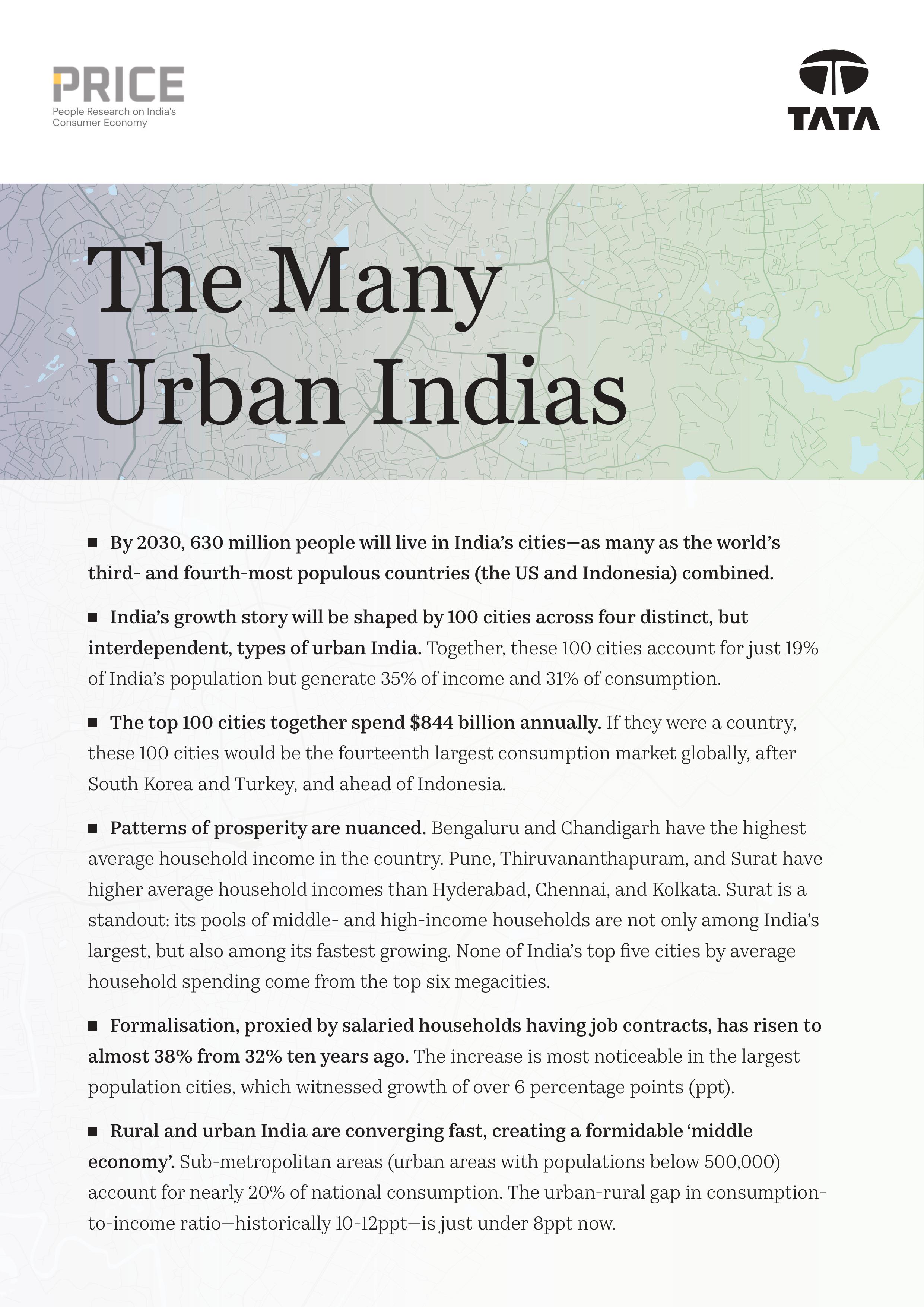
India's urban transformation is entering a decisive new phase. By 2030, nearly 630 million people will live in India's cities, making the country the largest contributor to global urbanisation. Yet this transformation is not being driven by a handful of metropolitan centres alone. It is increasingly shaped by a diverse network of cities with distinct economic structures, demographic characteristics, and development trajectories. Understanding these differences is essential for designing effective public policy, guiding private investment, and achieving the vision of Viksit Bharat 2047.
The Many Urban Indias, a joint publication of PRICE (People Research on India's Consumer Economy) and Tata Sons Limited, provides one of the most comprehensive household-level assessments of India's urban economy. Drawing on multiple rounds of PRICE's nationally representative ICE 360° Household Surveys, complemented by official statistics including the National Accounts Statistics, NSO Consumption Expenditure Surveys, NFHS, Census, and United Nations population projections, the study analyses how households in India's Top 100 cities earn, consume, save, borrow and build economic well-being. The report presents estimates for 2025–26 and projections to 2030–31, offering an evidence-based perspective on India's evolving urban landscape.
The report begins with a simple but powerful proposition: there is no single Urban India. India's Top 100 cities account for only 19 per cent of the country's population, yet generate 35 per cent of household income, 31 per cent of household consumption, and 47 per cent of household surplus income, making them the principal engines of economic prosperity. These cities are grouped into four distinct but interconnected categories: the Big Six, Boomtowns, Breakout Cities, and Frontier Cities. Each performs a different economic role, from global innovation and advanced manufacturing to regional services and emerging consumption markets. Together, they represent complementary pillars of India's urban economy rather than a single homogeneous market.
The findings challenge several conventional assumptions about urban development. Prosperity is no longer determined solely by city size. Bengaluru and Chandigarh record the highest average household incomes, while cities such as Pune, Surat and Thiruvananthapuram outperform several larger metropolitan centres. India's Top 100 cities together constitute an urban consumer economy of approximately US$844 billion, comparable to one of the world's largest national consumer markets. At the same time, middle-income households are becoming the dominant urban segment, formal employment continues to expand, consumption is shifting towards housing, transport, education and discretionary spending, and smaller cities are emerging as the next frontier of household demand and wealth creation. Rural and urban India are also converging rapidly, creating a dynamic "middle economy" that is reshaping consumption and labour markets.
Beyond documenting current trends, the report introduces a broader framework for understanding India's urban future. It argues that cities should increasingly be viewed as economic systems, not merely administrative units. Household prosperity, savings, asset ownership, labour market formalisation, financial resilience and health outcomes provide a richer understanding of urban development than population growth alone. This perspective has important implications for national urban policy, infrastructure planning, fiscal devolution, industrial strategy and business decision-making.
The report concludes that India's next phase of growth will depend not on the expansion of a few megacities but on the collective dynamism of a diverse network of interconnected urban economies. As India moves towards becoming a developed nation, policies must recognise the differentiated strengths of cities, strengthen connectivity between them, and promote inclusive, competitive and evidence-based urban development. The future of India's economy will not be written by one city or even a handful of metropolitan centres. It will be written across the many Urban Indias.
The Many Urban Indias
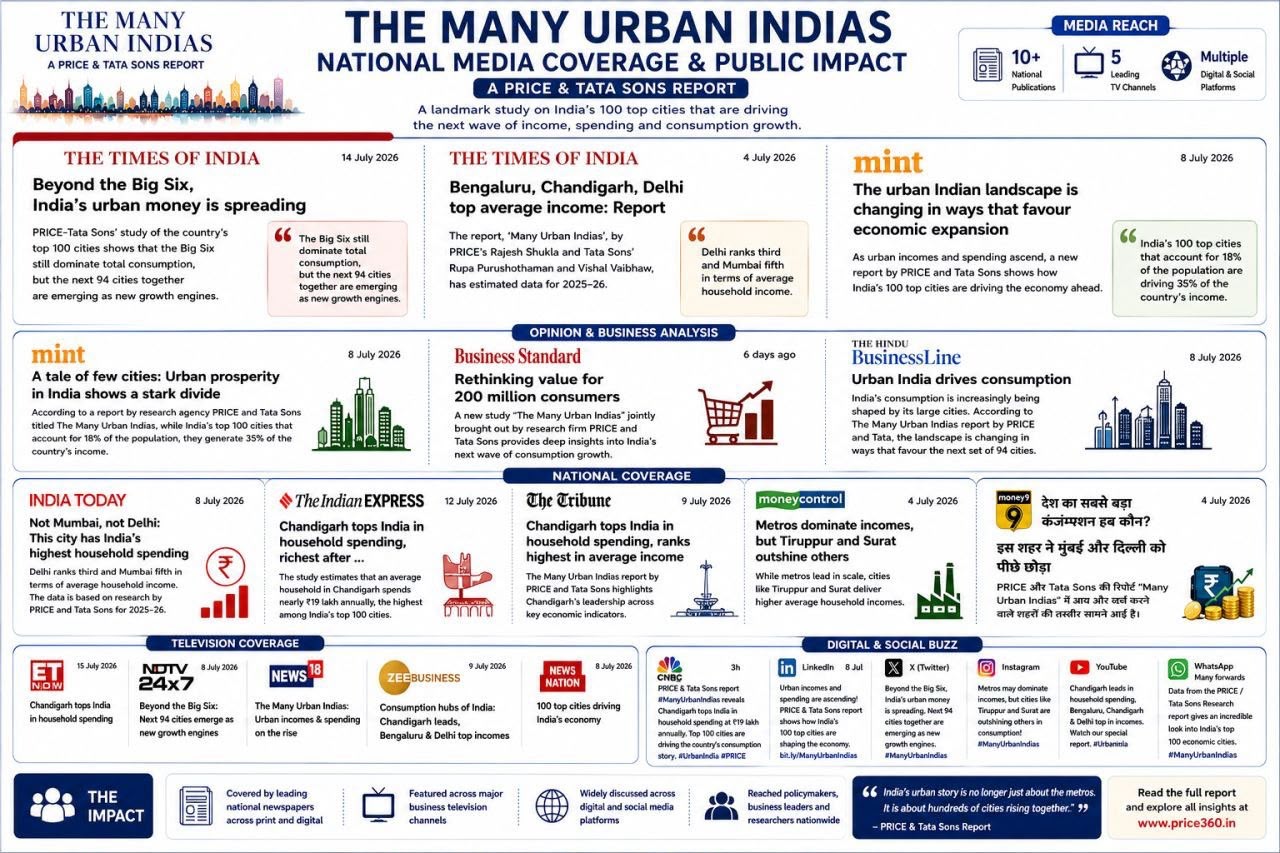
We are humbled by the overwhelming national response to The Many Urban Indias, our joint report with Tata Sons.
Featured across #TheTimesofIndia #Mint #IndiaToday #BusinessStandard #TheIndianExpress #BusinessLine #Moneycontrol, leading TV channels, and digital platforms, the report has sparked a national conversation on India's changing urban economy.
Thank you to all friends, the journalists, editors, policymakers, researchers, and readers for engaging so thoughtfully with our work.